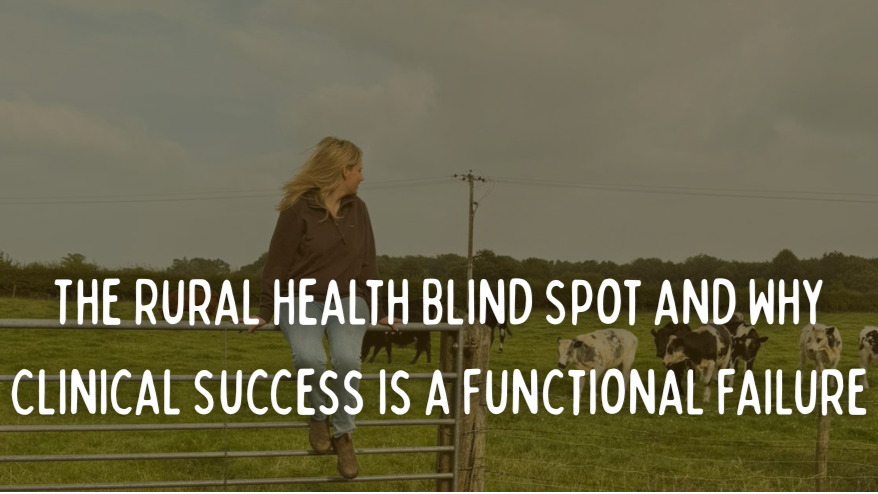
I have spent my life moving between worlds that rarely speak the same language. I come from a farming background, I work in community/ public health, and I am an Occupational Therapist. This triple-lens has revealed a glaring gap in how we design rural healthcare: we are pretty good at treating the patient, but we are consistently failing the individual. In the current policy circles, we measure success through clinical outcomes like wait times, bed days, and pharmaceutical management. However, if you are a healthcare professional working in a rural patch, you know that these metrics fail to capture the reality at the farm gate. For a farmer, health is not an abstract concept or a set of lab results; it is a functional necessity that dictates their very existence.
When we ignore the practicalities of a farmer’s daily life, we overlook the most critical factor in their long-term recovery, which is their ontological security. For those of us from farming families or in farming, work isn’t just a task we perform from nine to five; it is the foundation of who we are. In sociology, ontological security describes the stability we feel when our daily lives have continuity and purpose. When a farmer faces a health challenge, they aren't just worried about a diagnosis or a recovery timeline, they are facing a profound identity crisis. If they can no longer hitch a trailer, move livestock, or navigate their own yard, their sense of self begins to fracture. As healthcare professionals, if we focus solely on the clinical fix while ignoring the doing, we aren't just leaving the job half-finished; we are leaving that person in a state of deep psychological instability.
The tragedy of our current system is that it remains almost entirely reactive. We wait for the injury, the fall, or the total physical breakdown before we attempt to intervene within the sterile four walls of a clinic. But true rural health requires a ‘Boots on the Ground’ philosophy that moves beyond the hospital ward. What is actually needed is a systemic shift toward preventative care that is embedded within the community itself, for our farmers we need to start looking at the farm as the primary clinical setting. This means moving away from generic advice, like telling a farmer to "rest for two weeks" during lambing season, and toward a model of contextual care. We should be analysing the physical demands of the farm before the injury happens, partnering with farmers to modify their machinery and yard layouts to fit their changing physical needs as they age.
We must stop treating rural health inequalities as a simple matter of access to services and start questioning the type of service we are providing. If we want our farming communities to stay strong, our policies and strategies must stop treating the human body like a machine with isolated broken parts. Instead, we must treat the person as an inhabitant of a specific, demanding environment, we need to fund and integrate functional, occupation-based care that values a farmer’s (or anyone’s for that matter) ability to work and do the things they love just as highly as their heart rate or blood pressure.
Functional independence is the most effective preventative medicine we have, and it is time our healthcare strategy reflected the reality of the people it is meant to serve.
By Harriet McCartney 19th March 2026
Acre & Antler work with Rural and Farming communities with tailored personal support in all things from managing burnout to improving processes. To find out more click the link above or visit the services page.
We also offer a 25% off discount to all farmers seeking help just enter code AGRI25 when booking!